On
May 14, 2015, a KTK Visoko employee named Muhamed kindly offered to
show me an ancient tunnel, the entrance to which is on the edge of the
property.
KTK Visoko is a leather processing plant that was closed for 20 years during the Rothschild/U.N./Serbian war against the Bosnian people. A company called Prevent purchased the clothing plant in June 2014, but the factory continues to have a largely abandoned look.
KTK Visoko is a leather processing plant that was closed for 20 years during the Rothschild/U.N./Serbian war against the Bosnian people. A company called Prevent purchased the clothing plant in June 2014, but the factory continues to have a largely abandoned look.
 |
| KTK Visoko leather processing plant, abandoned for 20 years because of the Rothschild/U.N./Serbia war against Bosnia, and only recently purchased by Prevent. |
Muhamed and I walked across the empty factory grounds toward the Bosna River, a large river that meets the Fojnica River nearby.
Approaching KTK
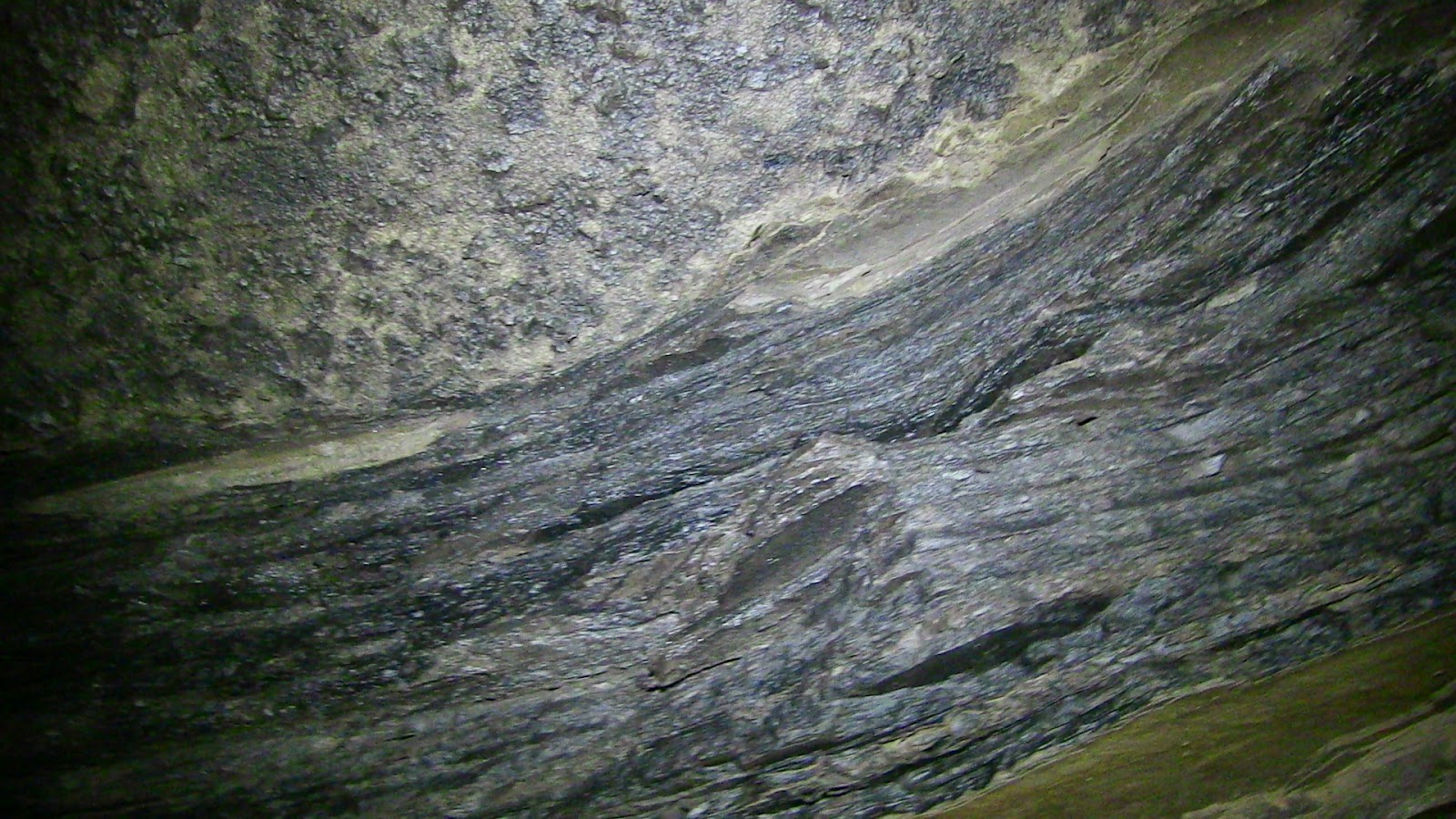
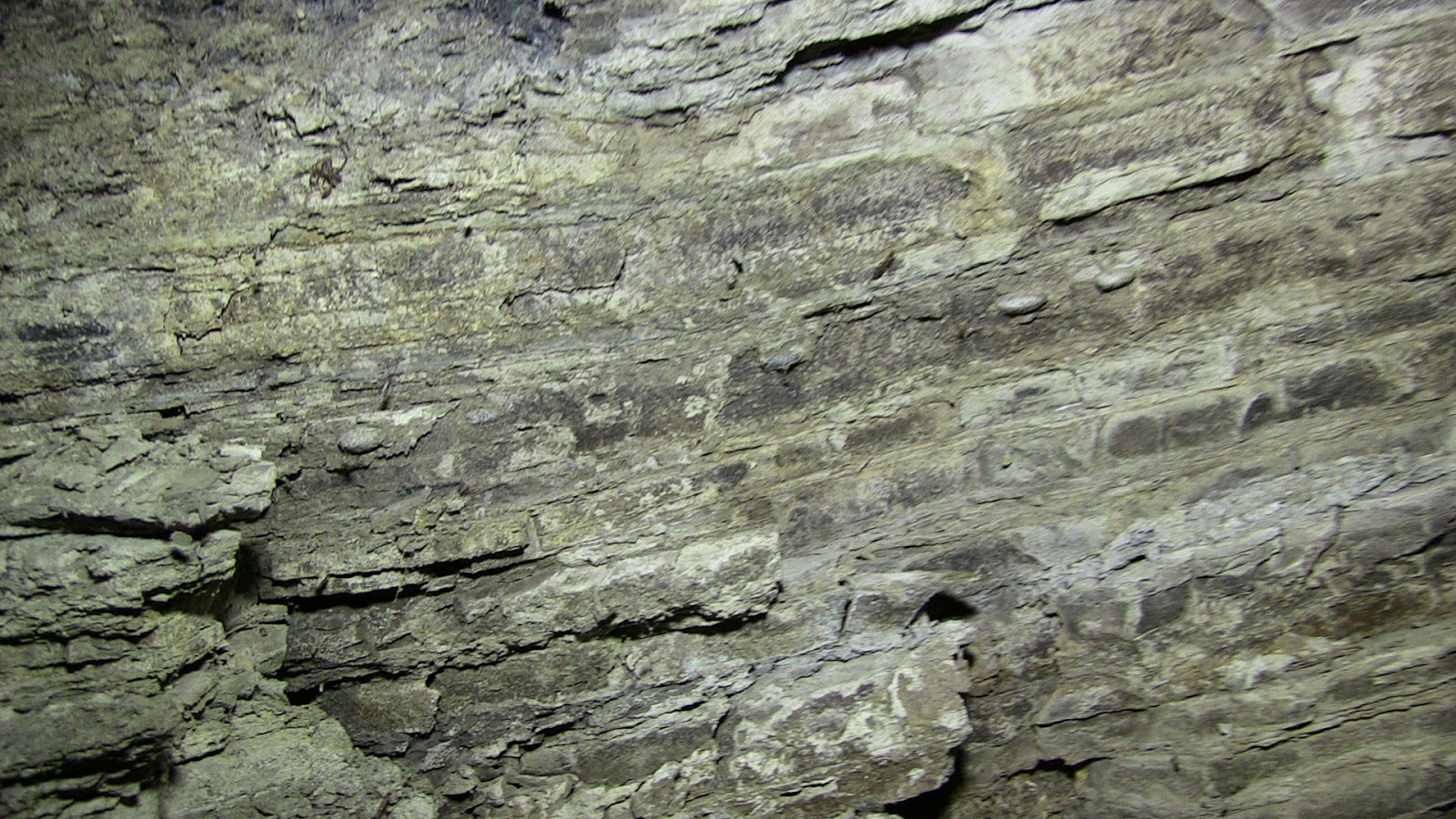
On the southwestern bank of the Bosna River, just below the tunnel entrance, an ancient artificial claystone block lay deeply embedded into the hill just above water level. The block was steeply inclined into the artificial claystone/clay hill. This was the first clue that the hill in which KTK Tunnel found itself was not a natural feature of the landscape but an ancient built structure.
 |
| Structurally inclined 1) claystone block and 2) clay layers composing an ancient artificial hill on the southwestern bank of the Bosna River in Visoko, Bosnia |
 |
| Structurally inclined 1) claystone block and 2) clay layers composing an ancient artificial hill on the southwestern bank of the Bosna River in Visoko, Bosnia |
 |
| Structurally inclined 1) claystone block and 2) clay layers composing an ancient artificial hill on the southwestern bank of the Bosna River in Visoko, Bosnia |
 |
| Structurally inclined 1) claystone block and 2) clay layers composing an ancient artificial hill on the southwestern bank of the Bosna River in Visoko, Bosnia |
Exploring KTK
 |
| KTK Tunnel entrance on the bank of the Bosna River. Note artificial clay layers 1) inclined into the hill to assure structural strength and 2) inclined toward the tunnel itself. The modern wooden frame has no support role. |
 |
| The left side of the outer tunnel entrance shows steeply inclined structural clay layers composing an ancient artificial hill. |
 |
| The left side of the outer tunnel entrance shows steeply inclined structural clay layers composing an ancient artificial hill. |
 |
| Left side of the outer tunnel entrance: Structurally inclined clay layers composing an ancient artificial hill |
 |
| Left side of the outer tunnel entrance: Structurally inclined clay layers composing an ancient artificial hill |
 |
| Left side of the outer tunnel entrance: Structurally inclined clay layers composing an ancient artificial hill |
 |
| Left side of the outer tunnel entrance: Structurally inclined clay layers composing an ancient artificial hill |
 |
| Left side of the outer tunnel entrance: Structurally inclined clay layers composing an ancient artificial hill |
 |
| Left side of the outer tunnel entrance: Structurally inclined clay layers composing an ancient artificial hill |
 |
| Right side of the outer tunnel entrance: Structurally inclined clay layers composing an ancient artificial hill |
 |
| Right side of the outer tunnel entrance: Structurally inclined clay layers composing an ancient artificial hill |
 |
| Ceiling of tunnel entrance: Structurally inclined clay layers support ceiling layers |
 |
| Ceiling of tunnel entrance: Structurally inclined clay layers support a single piece of ceiling clay |
 |
| Ceiling of tunnel entrance: Structurally inclined clay layers support a single piece of ceiling clay |
 |
| Ceiling of tunnel entrance: Structurally inclined clay layers support a single piece of ceiling clay |
 |
| Ceiling of tunnel entrance: Structurally inclined clay layers support ceiling clay layers |
 |
| Ceiling of tunnel entrance: Structurally inclined clay layers support ceiling clay layers |
 |
| Ceiling of tunnel entrance: Structurally inclined clay layers support ceiling clay layers |
 |
| Ceiling of tunnel entrance: Structurally inclined clay layers support ceiling clay layers |
 |
| Ceiling of tunnel entrance: Structurally inclined clay layers support ceiling clay layers |
 |
| Ceiling of tunnel entrance: Structurally inclined clay layers support ceiling clay layers |
 |
| Ceiling of tunnel entrance composed of structurally inclined clay layers |
 |
| Government-mandated support posts and beams. The clay pieces that have broken off over time collect on the flat wooden "roofs" and eventually collapse them, thus creating life-threatening danger for visitors. Without the government's interference, only one clay piece at a time would fall, a circumstance manageable with a simple hard-hat. |
 |
| Government-mandated
support posts and beams. The clay pieces that have broken off over
time collect on the flat wooden "roofs" above the posts and eventually collapse them, thus creating life-threatening danger for visitors. Without the government's interference, only one clay piece at a time would fall, a circumstance manageable with a simple hard-hat. |
 |
| Government-mandated
support posts and beams. The clay pieces that have broken off over
time collect on the flat wooden "roofs" above the posts and eventually collapse them, thus creating life-threatening danger for visitors. Without the government's interference, only one clay piece at a time would fall, a circumstance manageable with a simple hard-hat. |
 |
| Government-mandated
support posts and beams. The clay pieces that have broken off over
time collect on the flat wooden "roofs" above the posts and eventually collapse them, thus creating life-threatening danger for visitors. Without the government's interference, only one clay piece at a time would fall, a circumstance manageable with a simple hard-hat. |
 |
| Government-mandated
support posts and beams. The clay pieces that have broken off over
time collect on the flat wooden "roofs" above the posts and eventually collapse them, thus creating life-threatening danger for visitors. Without the government's interference, only one clay piece at a time would fall, a circumstance manageable with a simple hard-hat. |
 |
| Government-mandated
support posts and beams. The clay pieces that have broken off over
time collect on the flat wooden "roofs" above the posts and eventually collapse them, thus creating life-threatening danger for visitors. Without the government's interference, only one clay piece at a time would fall, a circumstance manageable with a simple hard-hat. |
 |
| Government-mandated
support posts and beams. The clay pieces that have broken off over
time collect on the flat wooden "roofs" above the posts and eventually collapse them, thus creating life-threatening danger for visitors. Without the government's interference, only one clay piece at a time would fall, a circumstance manageable with a simple hard-hat. |
 |
| Government-mandated
support posts. The clay pieces that have broken off over time
collect on the flat wooden "roofs" above the posts and eventually collapse them, thus creating life-threatening danger for visitors. Without the government's interference, only one clay piece at a time would fall, a circumstance manageable with a simple hard-hat. |
 |
| Second tunnel entrance, inaccessible from the outside because the hill is too steep |
 |
| Second tunnel entrance, inaccessible from the outside because the hill is too steep |
 |
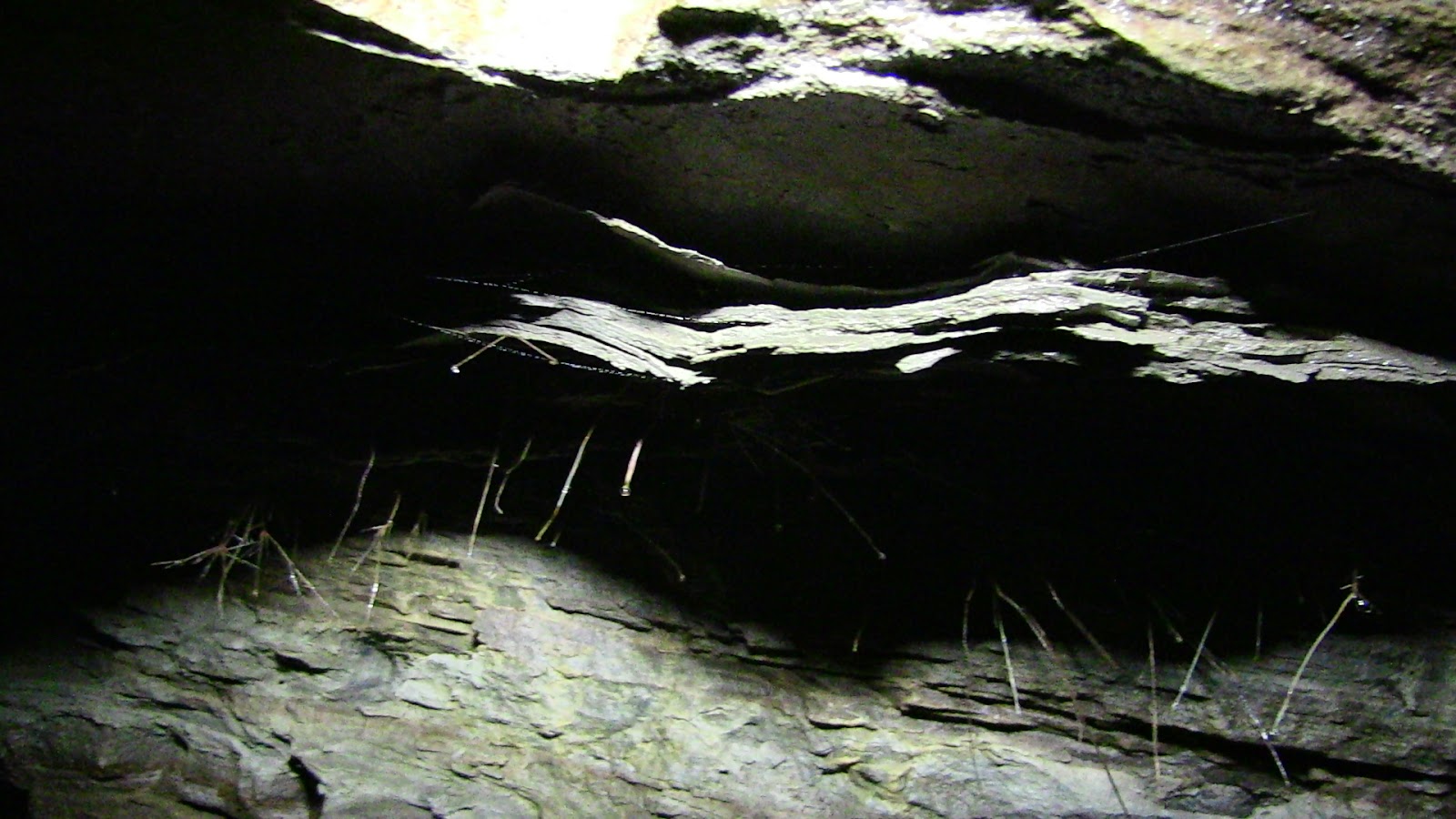
| One piece of level claystone composes the ceiling |
 |
| One piece of level claystone composes the ceiling |
 |
| One piece of level claystone composes the ceiling |
 |
| One piece of level claystone composes the ceiling |
 |
| One piece of level claystone composes the ceiling |








When Was KTK Tunnel Built, and Who Built It?
Clearly KTK tunnel was not built in modern or Roman times.
Building a tunnel-containing hill -- out of anything, but in this case out of clay and claystone layers -- that rises 60 feet above a river has no precedent in modern or Roman construction.
Further, there would be no reason for Romans or modern builders to build a tunnel with a ceiling height of between 10 and 15 feet.
With its extremely high ceiling, KTK Tunnel is an enigma. Why would human beings 5 to 6 feet tall build a tunnel twice their height?
Of course, there is copious paleontological evidence that humans have walked the earth who were anywhere from 9 feet tall to more than 25 feet tall. So the tunnel could have been built for 9-to-10-footers.
However, some of the passageways in Ravne Tunnel Labyrinth, which is part of the same pyramid complex that KTK Tunnel is, have ceiling heights of only 3-5 feet.
Thus, perhaps the tunnels were built, not for negotiation, but for something else.
Why Was KTK Tunnel Built?
We are left with the question: "Why would an ancient civilization build a claystone hill with empty space in the form of a high-ceilinged tunnel?"
We can give a partial answer to that question.
The entrances to KTK are 30 feet above the height of the Bosna River in springtime. The ancient hill -- and the other, much larger, structures in the Bosnian Pyramid Complex -- were built on what had been a level plain. If the tunnel entrance had not been placed high up, water would have flooded it immediately.
The ancients' solution to the problem of tunnel building, in this case, was to create their own hill, a hill that would protect the tunnel from flooding.
Of course, we still haven't answered the question of why they wanted to build a tunnel in the first place. Mysteries abound.
If you have any ideas on this subject, or if you have heard of or visited another tunnel that was built, not dug, please drop a line to the author.
* * * *
Jock Doubleday is a writer and videographer interested in
ancient civilizations. Some of his videos of various aspects
of the Bosnian Pyramid Complex can be viewed here: Archaeological Park
ancient civilizations. Some of his videos of various aspects
of the Bosnian Pyramid Complex can be viewed here: Archaeological Park

To contact Jock Doubleday, please write:
jockdoubleday dot writer at gmail dot com


